
AI Search for Tourism Operators and DMOs: What’s Changed and What to Do
October 30, 2025
If travellers in your area are asking AI tools “what should I do in [your region]?” and your business isn’t in the answer, you are invisible to those travellers. Not ranking low. Invisible.
Google’s AI Mode, ChatGPT, Gemini, and Bing Copilot have changed how people search for travel experiences. They no longer scroll through results. They ask a question and get a summarised answer. This guide explains what that means for operators and DMOs, what the research shows, and the practical steps to take now.
- How AI Is Changing the Way Travellers Search
- What This Means for Your Tourism Business
- SEO vs GEO: What’s Changed
- Are You Visible in AI Search? Self-Check
- What Operators Need to Do Now
- What DMOs Need to Do Now
- What’s Coming Next: Agentic AI
How AI Is Changing the Way Travellers Search
Travellers used to open ten browser tabs and compare options. Now they ask a full question and get one synthesised answer. “Looking for a relaxed long weekend in Noosa with ocean views and good seafood?” returns a curated summary, not a list of links.
McKinsey research shows more than half of travellers have already used AI tools to plan a trip. 70% say they would prefer a digital assistant that plans and manages their entire itinerary autonomously. The tab-opening behaviour is fading fast.
We tested this ourselves. Fab ran a live search for “things to do in Agnes Water 1770” in Google’s AI Mode. The destination marketing links that would normally appear in search results were gone from the AI summary. When the query shifted to “how do I book?”, Google surfaced Google Business Profile listings: operator websites, phone numbers, and booking buttons. No DMO website. Just operators with complete, verified listings.
That test exposed how the funnel has split. AI handles inspiration and research. GBP listings surface at the point of decision. DMO websites are being bypassed at both ends.
The numbers confirm it. AI Overviews now appear in 39% of searches. Traffic to Australian content sites from Google Search has dropped up to 35% year-on-year since AI summaries rolled out. Tourism Tribe’s own DMO clients are seeing around 30% traffic declines. The model has changed.
What This Means for Your Tourism Business
Most operators already feel behind on digital. AI search makes the gap feel bigger, but understanding it is the first step to closing it.
Tourism Tribe’s State of AI in Tourism 2025 report surveyed 90 Australian tourism organisations. Here’s what it found:
- 71% of operators and 79% of DMOs have started using AI tools
- Only 19% of operators feel confident using them
- 85% expect AI to positively impact their business in the next two to three years
- Main barriers: technical skills (40%), privacy concerns (33%), budget (31%)
Most operators are experimenting. A small number are building real capability. The ones building capability are already producing more content, showing up more consistently, and appearing in AI-generated travel summaries.
As Liz Ward, CEO of Tourism Tribe, put it in the report: “AI is rapidly reshaping how travellers discover, plan and book. Small businesses are under pressure to keep up with the pace of change.”
The tools most operators are already using, ChatGPT for content drafts, Canva Magic Studio for images, are a starting point. But the deeper shift is about visibility. Writing faster is one thing. Being found by AI search is another. The two require different work.
SEO vs GEO: What’s Changed
Traditional SEO gets you ranked in search results. GEO (Generative Engine Optimisation) gets you recommended by AI tools.
This distinction matters because AI tools don’t present ten options. They present one synthesised answer, drawn from three to five sources. Every other business is invisible.
SEO optimised for keywords. GEO optimises for comprehension. AI tools need to understand what you offer, who it’s for, where you operate, and why your content is trustworthy, all from your website’s structure and copy.
What AI search looks for:
- Schema markup: Is your content labelled for machines? LocalBusiness, FAQPage, and Article schema tells AI exactly what type of content it’s reading.
- Question-based content: “Is this tour family-friendly?” carries more weight than keyword density. AI answers questions. Your content should too.
- Publish dates and freshness: Pages without visible dates risk being treated as outdated, even if your offer is still running.
- E-E-A-T signals: Experience, Expertise, Authoritativeness, and Trust. AI favours content that demonstrates genuine knowledge of your subject.
- Conversational language: Natural phrasing that mirrors how guests actually ask questions performs better than polished marketing copy.
SEO = getting clicks. GEO = getting picked.
The practical shift is this: stop writing for keywords. Start writing to answer the questions your guests are already asking.
Are You Visible in AI Search? Self-Check
Run through these eight questions. Count how many you say yes to honestly.
- Do you spot a publish or last-updated date easily on your latest blog post?
- Do your service pages answer questions like “Is this tour family-friendly?” or “Do you run in wet weather?”
- Are there at least three FAQs in plain English on each of your key pages, with FAQ schema applied?
- Have you searched for your business type in Google AI Mode or ChatGPT, using prompts like “best things to do in [your location]”?
- Does your website use schema markup, including LocalBusiness, FAQs, and product reviews?
- Does your About page clearly explain who you help, what you offer, and where you operate?
- Is “AI recommendation” or “Chatbot” an option in your “How did you hear about us?” form?
- Are your blog posts tagged and linked to relevant categories, with links out to credible sources?
Your score:
- 7–8: Your site is well-positioned for AI visibility. Keep it current.
- 4–6: Partway there. A few targeted updates will move the needle.
- 0–3: Your business is likely invisible in AI-generated answers right now.
Question four is the fastest test you can do today. Search for the best experiences in your area in Google AI and ChatGPT. If you don’t appear, a competitor does.
What Operators Need to Do Now
The steps that improve AI visibility are the same steps that improve your overall digital presence. None of them require a developer.
Keep your Google Business Profile complete and current. Add photos, update hours, enable booking links, and add FAQs. When travellers shift from “what’s in this area?” to “how do I book?”, AI surfaces GBP listings directly. During Fab’s Agnes Water test, an operator’s ATDW listing appeared in Google AI results, bypassing the local DMO website entirely. Operators with complete, verified listings are already being found.
Ask for reviews and respond to them. AI uses reviews as trust signals. A listing with 80 detailed reviews and consistent operator responses reads as more credible than one with a handful of silent entries.
Align your ATDW listing, website, and GBP. Same business name. Same address. Same key experiences described consistently. Inconsistency across listings reduces how often AI recommends you.
Write content that answers real questions. “What’s included in the tour?”, “Is this suitable for young children?”, “What happens if the weather turns?” Answer these on your service pages, not buried in a PDF or hidden behind a contact form.
Add schema markup. Most SEO plugins handle this automatically when configured correctly. If you’re unsure whether your site has it, bring the question to a Digital Assistance Plan session.
Real operators are already doing this. Zeynep Testoni from Soul Clay Studios has been training ChatGPT on her brand voice. Michelle Bishop from Bangalay Luxury Villas uses AI to speed up on-brand content production. Alex Herlihy from Wildwood Kangaroo Valley uses ChatGPT for research and product development. They’re not IT experts. They’re operators who decided to learn by doing.
As Fab said at the Destination Sydney Surrounds South Visitor Economy Symposium: “In a sea of automated content, your job is to keep it real. Genuine experiences, honest storytelling, and five-star service will always win. AI helps you scale those messages, not replace them.”
What DMOs Need to Do Now
The DMO challenge is more structural than the operator challenge. DMOs have traditionally owned the dream and plan stages of the visitor cycle. AI is absorbing exactly those stages. When a traveller asks “what should I do in the Hunter Valley?”, AI generates the answer from content it trusts. If a DMO’s site is structured for search clicks rather than AI comprehension, it gets bypassed.
Tourism Tribe’s DMO clients are seeing around 30% traffic drops. Publishing more content is not the answer. Publishing better-structured content that AI tools can read, trust, and quote is.
The short version: add schema markup across the site, write question-based content, make sure all key information is accessible without JavaScript, and redefine success away from sessions toward discoverability in AI environments. Collaborate with your operators, their structured listings are already appearing in AI results ahead of DMO websites in some destinations.
We’ve covered the full picture in a separate guide written specifically for DMO teams: AI Search and Destination Discovery: 15 FAQs for DMOs. It goes deep on how AI tools interpret destination websites, what AEO looks like for a DMO, how to measure AI visibility, and how to work with operators on a shared digital foundation.
What’s Coming Next: Agentic AI
AI search is the first shift. Agentic AI is the next one, and it goes further.
Agentic AI systems don’t just summarise and recommend. They act. These tools plan itineraries, compare options, and book on behalf of the traveller, without the traveller visiting a website at all.
McKinsey’s Remapping Travel with Agentic AI report predicts that 70% of consumers will prefer an AI assistant managing their entire trip autonomously. Early versions are already operating. SkyLink automates flight and accommodation booking for corporate travellers within seconds.
For operators, this shift will require accurate and current product data across every platform. An AI agent booking on a traveller’s behalf needs live availability, consistent descriptions, and working booking links. If your listing is stale or your schema is missing, the booking goes elsewhere.
For DMOs, agentic AI reinforces why your website must function as a machine-readable information source. Not a brochure. A structured layer that AI agents draw from when they’re building itineraries for someone who may never visit your page.
As Fab said in the 2025 AI in Tourism report: “If we don’t act now, we risk leaving parts of the industry behind, especially those in small business and regional tourism.”
The businesses building GEO foundations now are the ones agentic AI will find first.
For a practical guide to building those foundations, read the AI in Tourism Playbook for Q2 2026.
Frequently Asked Questions
The fundamentals haven’t changed. Travellers still want genuine experiences. What’s changed is how they find them. Structure your digital presence so AI tools understand what you offer, and the same authentic content that impresses your guests becomes the content AI recommends.
Start with the self-check above. Pick one thing to fix this week: your Google Business Profile, one service page FAQ, or a blog post built around a real question your guests ask. GEO readiness is built one piece at a time.
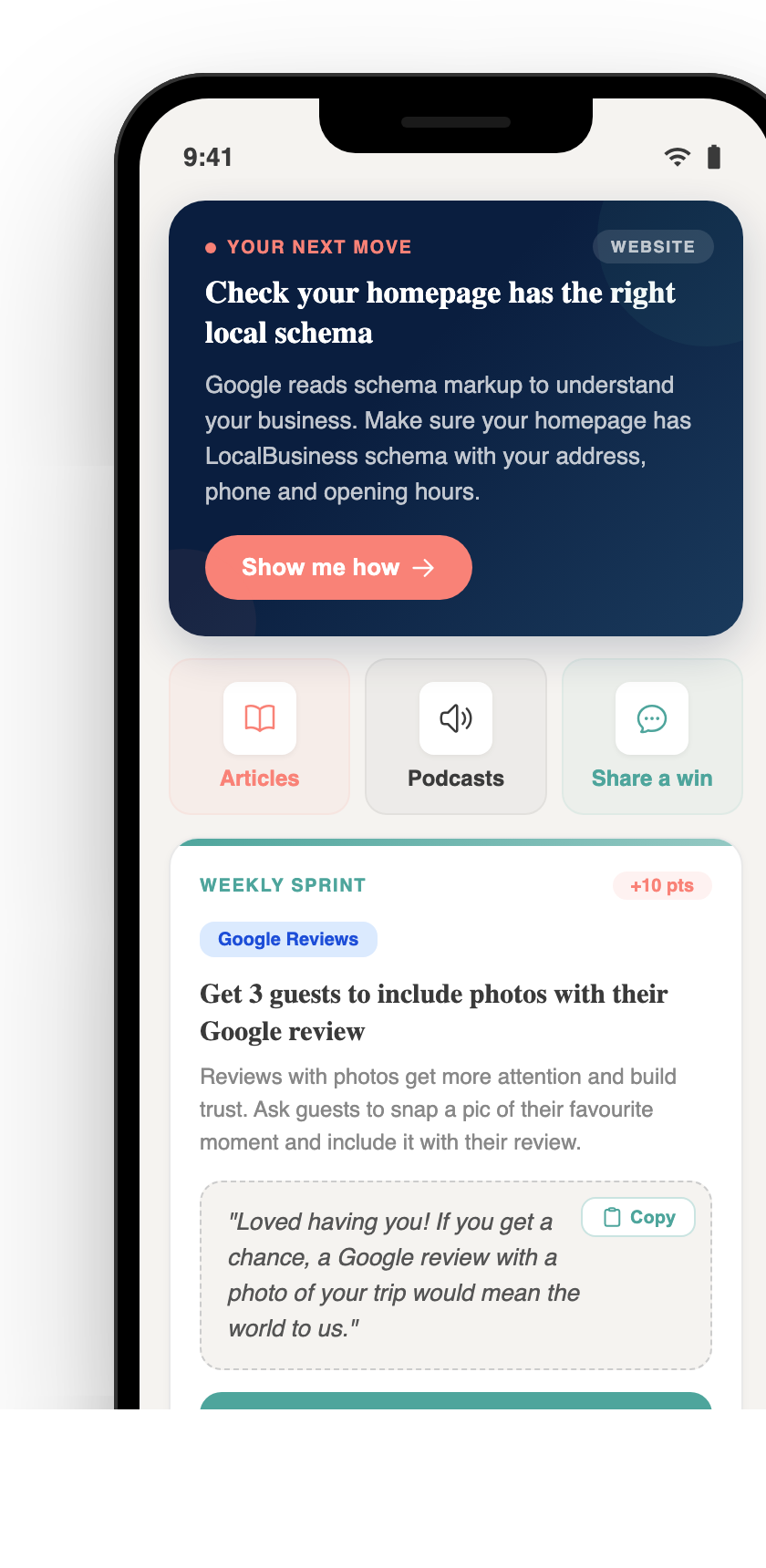
Pocket Rocket App — Free
Your free AI marketing coach, right in your pocket
The free Pocket Rocket app gives you a personal AI marketing coach, website audit, weekly action plans and 5-minute tips. Built for tourism operators.