
Tourism Tribe Playbook
AI in Tourism: A Practical Playbook for Q2 2026
Use cases, tools, and outcomes for operators, councils, and tourism organisations.
71%
of Australian tourism operators have started using AI
19%
feel confident doing it
78%
are sole operators or micro businesses with fewer than 5 people
900M+
weekly ChatGPT users searching for travel info
Q2 2026 Snapshot
Where the Industry Stands Right Now
Tourism operators are managing real pressures right now. Rising fuel costs, shifting international travel patterns, and global uncertainty are affecting inbound markets. Some source markets have slowed. Operators who built their businesses around international visitors are feeling it.
Whilst the industry is optimistic that domestic travel will be maintained, the economic pressures are eroding forward bookings. Reminiscent of COVID-19 trends, operators are looking to different markets with higher disposable income, and local and hyper-local marketing is more relevant than it has been in years.
Global geopolitical and economic factors control the flow of tourists and cash.
What you control right now is how well your business shows up in AI search, how effectively you reach the travellers who are still travelling, and how efficiently you run your marketing.
The operators getting through this period are the ones doubling down on local visibility, community partnerships, and the markets that are still moving.
Daily practical tips in Pocket Rocket
Tourism Tribe is publishing daily tips focused on two priorities: hyper-local marketing to reach locals and domestic travellers in your region, and researching the markets that are still travelling to Australia. This is not about waiting for conditions to improve. It is about working smarter with the visitors already looking for you.
Setting the Scene
How we got here — and what it means for your business
The ChatGPT moment arrived in late 2022. For the first time, the general public grasped what AI could actually do. Not as a science fiction concept, but as a tool they could open in a browser and use today.
Tourism Tribe’s research tells the story from the inside. 79% of DMOs and 71% of operators have started using AI. But only 19% of operators feel confident. 85% expect AI to positively impact their business in the next two to three years. The tools they use most: ChatGPT, Canva Magic Studio, AI-powered social media scheduling. The main barriers: technical expertise (40%), privacy concerns (33%), budget (31%). Source: Tourism Tribe’s ‘State of Artificial Intelligence in 2025’ report.
In 2025, 61% of all global venture capital went to AI firms. Double the share from 2022 (OECD, Feb 2026). Google AI Overviews launched in Australia in late 2024. AI search became the default for many users without them needing to visit a LLM (large learning model) chatbot.
50%+
of searches now show AI Overviews (The Digital Bloom, 2025)
63%
of destinations saw year-on-year traffic declines (Tempest, 2025)
33%
decline in Google search traffic to major publishers in 2025 (Press Gazette)
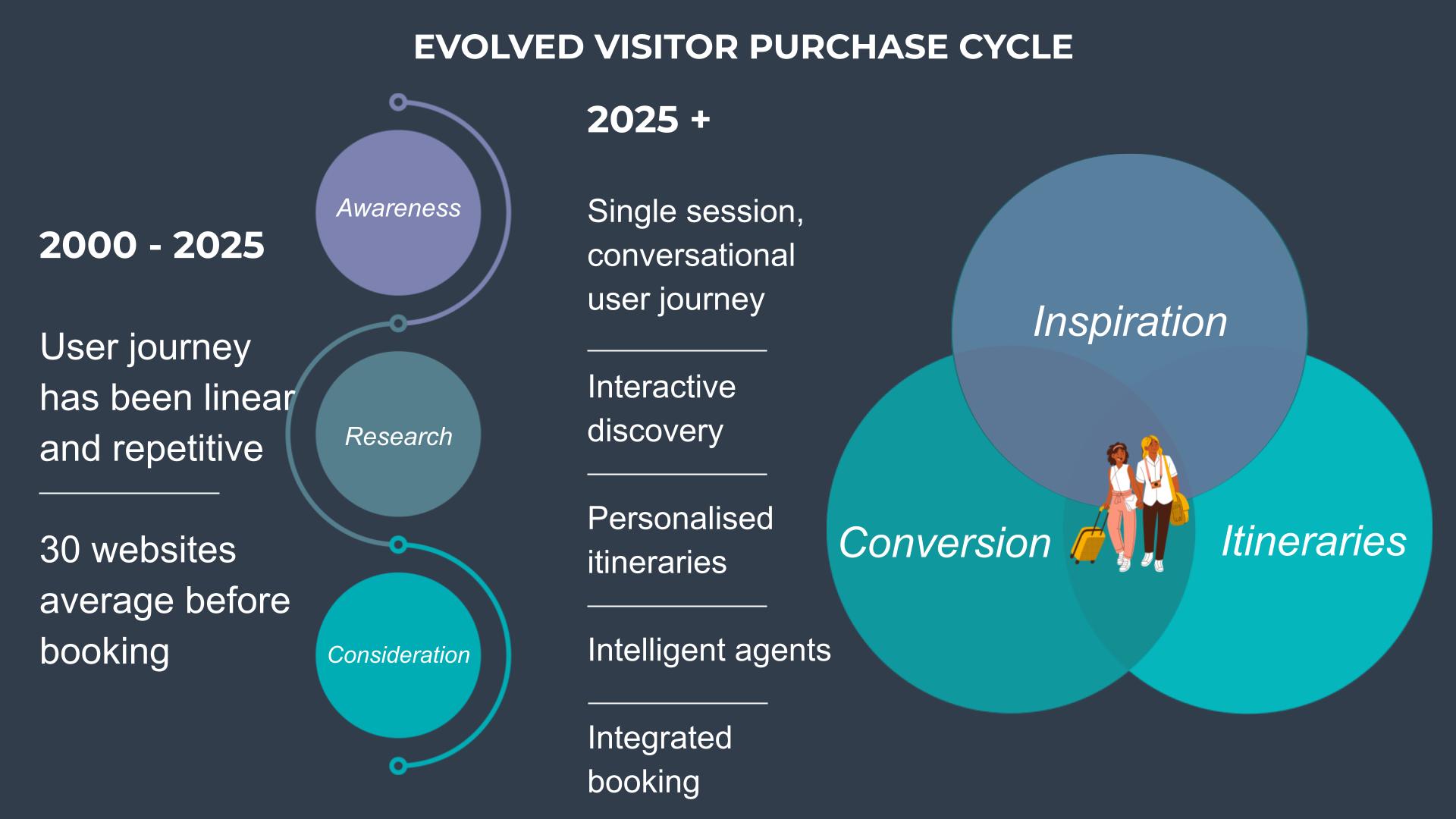
The result: the 25-year-old linear customer journey (awareness, research, consideration, booking) has been compressed into a single conversational session. A traveller asks an AI agent to research and recommend. They receive a shortlist. They book. Sometimes without visiting a single DMO (Destination Marketing Organisation) or operator website.
Changing role of key channels
In this new AI marketplace, three digital channels matter most. Each plays a distinct role in how AI search engines discover, validate, and recommend your business. Getting these right is no longer a marketing nice-to-have. It is how you stay visible.
Website
Structure & Deep Answers
Your website is the primary source AI engines pull from when answering detailed queries. Structured content, FAQ schema, and clear entity information make you citable. Without this, AI tools either ignore you or get your details wrong.
Google Business Profile
Recency, Location & Proof
Your GBP signals that you are real, current, and local. Reviews, photos, updated hours, and regular posts tell AI engines your business is active. This is your proof of credibility in local and destination-based queries.
Social Media
Validation & Trust
Social content validates what your website claims. Authentic posts, guest interactions, and real-time updates signal that your business is active and engaged. AI engines increasingly cross-reference social presence when building recommendations.
Discovery now happens upstream in AI. By the time a traveller reaches your website, they have already been recommended (or not) by an AI tool. Your website provides the deep, structured answers that AI engines need to cite you correctly. Your GBP proves you are real, current, and local. Social media validates your claims and shows you are an active, engaged business.
These three channels work together. A strong website with weak social presence looks abandoned. A polished GBP with a thin website gives AI engines nothing to cite. Neglecting one weakens the others. The operators who show up consistently across all three are the ones AI tools recommend with confidence.
The new decision process
The traditional marketing funnel assumed you controlled the top. You ran ads, optimised for keywords, and pushed people into your pipeline. That model is broken. AI now controls the discovery phase. Your job is to make sure your digital presence passes the validation and trust stages that follow.
Discovery
Happens Upstream in AI
Validation
Happens Across Your Channels
Trust
Closes the Booking
You cannot buy your way into an AI recommendation. You earn it by having clear, structured, consistent information across your website, GBP, and social channels. When an AI tool pulls your details, the information needs to match everywhere. When a traveller checks your social feed after seeing an AI recommendation, they need to see an active business. When they land on your website, they need to find the specific answers the AI promised.
Why Tourism Tribe
Not observers. Practitioners.
Tourism Tribe has been supporting tourism operators since 2007. This playbook is not a literature review. It is a culmination of the team’s own AI business transformation, informed by grass-roots engagement with councils, regional tourism organisations, and operators across Australia.
The team has been through its own AI transformation. Testing tools before recommending them and training operators on their use. Building proprietary tools (Robin, Marketing Mate, Review Milker, Pocket Rocket) from the inside out, with operator needs driving every decision.
The mission: open access to current and future-focused information that can be easily applied. The playbook is free because that is how Tourism Tribe has always operated. Share what works. Build capability, not dependency.
By the numbers
Transparency
How we used AI to develop this document
Lived experience (coaching operators, consulting, Tourism Tribe’s own AI transformation) is the DNA of this document. AI tools were used for drafting, structuring, and synthesising research. The strategy, editorial judgment, source validation, and final decisions were human.
What AI contributed
- Drafting initial section structures from brief notes and transcripts
- Synthesising survey data into readable summaries
- Generating candidate tool descriptions for human review
- Formatting and reorganising content at speed
What humans contributed
- Strategic decisions on what to include and how to frame it
- Source validation and fact-checking
- Editorial judgment on tone, emphasis, and sequencing
- Final sign-off on every section before publication
Our Approach
Agile, curious, low-to-medium risk
71% of Australian tourism operators have started using AI. Only 19% feel confident doing it (‘State of AI in Tourism 2025’). That gap is the problem this playbook addresses.
AI is a tool, not a strategy. You still need to know your customer, your product, and your market. AI makes the execution faster. It does not replace the judgment you have built from years in the industry.
The goal is capability, not dependency. The operators who get the most from AI are not the ones paying for the most subscriptions. They are the ones who picked two or three tools, used them consistently, and now own those skills. They are not locked into an agency retainer or a monthly fee for something they half-understand.
The risk appetite here is low to medium. We are not recommending anyone rebuild their business around a tool they saw in a LinkedIn post. We are recommending tested approaches that have worked for thousands of tourism businesses across Australia. If something is still experimental, we say so.
Curiosity is the only requirement. You do not need to be technical. You need to be willing to try one thing, measure whether it worked, and decide whether to keep going. That is the entire framework. Everything else in this playbook is the detail.
One more thing: 78% of Australian tourism businesses are sole operators or micro businesses with fewer than five people (Tourism Research Australia, June 2024). This playbook is written for that reality. Not for an enterprise with a digital team. For the operator who handles their own Instagram between tours.

Skills
Where are you? The AI Driver’s Licence
Three stages of AI capability. Each builds on the last. Most Australian tourism operators sit at L-plates. A growing number are on P-plates. Very few have reached full licence. That is where the compounding efficiency gains live.
L-Plates
Learning the basics
You are chatting to AI with limited context, no customer persona, and no brief. That is a starting point but will return low quality results.
It is like you are asking an untrained receptionist to give you advice. Generic input produces generic output.
- Using ChatGPT for basic searches and quick questions
- Copy-pasting AI output directly without editing
- One tool, limited prompts, no memory or context
- Unpaid subscription with limitations on usage and security
P-Plates
Building a real workflow
You have a business profile your AI knows. You use it for specific, repeatable tasks. You are starting to use more powerful tools alongside the basics.
- Custom GPTs or Gemini Gems with your brand voice
- NotebookLM for synthesis and research
- Gamma.app for presentations and reports
- Gemini image editing: adding people to empty restaurant tables
- Pocket Rocket for website audits and AEO scoring
Full Licence
Orchestrating, not just using
The skill set required now is not writing code. It is coordination and orchestration. You are thinking about AI as a team of agents, each with qualifications and context.
- Documented business processes ready for automation
- Multi-agent workflows for booking, invoicing, and follow-up
- “Each agent needs qualifications, skills, and context” — Fabienne Wintle, Untangling Tourism Tech Podcast Ep 18
- Measuring AI ROI, not just saving time
The microphone button tip: most operators do not know it exists
Every major AI tool has a microphone button. Speaking to AI produces better outputs because you naturally use more context and expression than when you type. Try it once and you will not go back. Look for the microphone icon in ChatGPT, Claude, and Gemini.
Trust & Authenticity
Using AI without losing your voice
The data is unambiguous: authentic, human content outperforms polished AI content on social media. The risk is not that AI is bad. It is that AI content that feels too perfect breaks trust. We wrote about why AI-generated content sounds like AI (and how to fix it).
77%
77% of consumers are more likely to engage with content that feels genuine and relatable” (Sprout Social)
47%
only 47% of global consumers trust marketing and advertising messaging” (Edelman Trust Barometer)
The rule
“AI is a drafter, not a publisher. AI prepares the work; humans review and post. The voice, the judgment, and the final decision are always yours.”
“We used to charge thousands of dollars for a marketing and social media plan and now we can offer our customers a free starting draft through the CustomGPT we created “Tourism Marketing Mate.” Liz Ward, Tourism Tribe
State of Play
What is proven in Q2 2026
Some AI use cases have moved from experimental to reliable. Others are promising, but not yet proven at scale for small tourism businesses. Here is where things actually stand.
Proven
Proven
Content generation
ChatGPT, Claude, and Gemini all work for drafting social posts, blog content, and email copy. Three in five tourism operators now use AI for this. The quality depends almost entirely on how well you prompt it and how well you know your own brand voice. AI writes generic. You have to push it to write specific.
Proven
AI search visibility (GEO)
ChatGPT now has more than 800 million weekly users. Perplexity handles 780 million monthly queries. Google AI Overviews appear in up to 60% of searches. Traditional search traffic is projected to drop 25% by 2026. Read more about how AI search is transforming tourism marketing. If AI cannot find your business, a growing share of travellers cannot find you. Schema markup, structured FAQs, and entity-rich content are the fixes. Learn how schema markup helps AI understand your business. This is not optional for operators who rely on search traffic.
Proven
AI-powered website audits
Automated scanning tells operators where they stand across eight categories: content quality, structured data, booking findability, and more. Benchmarked against thousands of Australian businesses, an audit gives operators a priority list instead of a theory. Do this first.
Proven
Review response automation
AI drafts responses to Google and TripAdvisor reviews. A human approves or edits before posting. For operators with high review volume, this saves two to four hours a week without sacrificing quality.
Proven
AI image and video editing
Canva and CapCut with AI features. Background removal, batch resizing, talking head reels. Operators are producing production-quality content from a phone. This is one of the highest-value, lowest-risk entry points for operators who are camera-shy.
Proven
Dynamic pricing
Proven for accommodation and tour operators with variable demand. AI adjusts rates based on demand signals, seasonality, and competitor pricing. Not relevant for every business model, but where it fits, the upside is significant.
Emerging
Emerging
- AI agents for destination management, including automated 24/7 visitor Q&A and listing management, are working in pilot environments but are not yet reliable as a set-and-forget solution.
- AI-assisted grant writing is useful as a first draft but still needs significant human editing.
- Predictive visitor modelling by season, demographic, and spend is valuable at scale but requires data volumes most small operators do not have.
- Fully autonomous booking via AI is not ready. ChatGPT attempted it and pulled back.
- Real-time personalisation for micro businesses requires integrations that are not yet mature.
Use Cases
Use cases by organisation type
Practical AI applications tailored to your situation. Pick your tab.
78% of Australian tourism businesses are sole operators or micro teams with fewer than five people (Tourism Research Australia, June 2024). Marketing is what happens in the spare moments between tours, check-ins, and cleaning rosters. Most operators have tried ChatGPT at least once. Few use it systematically, with consistent prompts and a clear workflow. These are the eight use cases that deliver the most value for the least effort.
AI website audit
Get a baseline score across eight categories before you do anything else. An AI readiness audit tells you exactly where your site stands and what to fix first. It removes the guesswork and stops you spending time on the wrong things.
Content batching
Generate a month of social posts in one sitting. Use AI to produce the raw drafts, then edit for your voice and local knowledge. This is not about automating your personality out of your content. It is about removing the blank-page problem that stops most operators from posting consistently.
AI-assisted marketing plan
Build your unique selling proposition (USP), content pillars, and a four-week social calendar in 30 minutes using a tourism-specific tool. For operators who have never had a marketing plan, this is the fastest way to get one. For operators who have, it is a useful annual reset.
Review repurposing
Turn your best guest reviews into Instagram captions, blog content, and social posts. Reviews are the most credible marketing content a tourism business has. Most operators post them once and forget them.
Schema markup for AI visibility
Add structured data to your website so AI search engines (ChatGPT, Gemini, Perplexity) can read and cite your business accurately. Without it, AI tools either ignore you or get your details wrong. With it, you appear in answers that travellers are getting right now.
FAQ writing for AI search
Write answers to the ten questions your guests ask most often and publish them on your website with FAQ schema. These are the exact queries going into AI tools. If your answer is on your site in a readable format, AI will cite you. See our guide to writing FAQs that AI search engines cite.
AI email and enquiry drafting
Use AI to draft responses to common enquiries. You edit and send. Operators who manage high enquiry volumes in peak season report this as one of the highest-leverage changes they have made.
AI image editing
Remove backgrounds, batch-create social tiles, resize for every platform. Canva’s AI features alone will save most operators two to three hours a week on visual content production.
Skills required
The skills this requires are not technical. Prompt writing and content vetting are the core marketing skills. Choosing two or three tools and sticking with them is the management discipline. Basic schema markup and Google Business Profile maintenance are the IT tasks, and most operators can handle both with a short tutorial.
Outcomes
Less time on content creation, more consistent online presence, higher visibility in AI search results, better conversion from website visitors, and less dependence on agencies or consultants for tasks you can do yourself.
Tourism is one of many responsibilities. Teams are often one or two people covering tourism alongside economic development, events, and grant administration. Budget cycles are real. The elected officials you report to want to see outcomes, not technology experiments. And you want to support local operators but do not have the delivery capacity to give each one hands-on help.
These are the six use cases that deliver the most value for councils in Q2 2026.
The opportunity OTAs cannot replicate
“This is actually the chance to shine for tourism organisations because they hold the real source of truth. They know where the best spot is for a picnic, at what time, on which beach — as opposed to OTAs, that’s not their game.” — Fabienne Wintle
Your region’s local knowledge is the one competitive advantage AI cannot invent. The opportunity: get it structured, published, and AI-readable before OTAs work around it.
Commission AI readiness audits across your operator base
Get a baseline across your top 20 to 50 tourism businesses before you design any support program. You cannot fix what you have not measured, and you cannot report outcomes to council without a starting point.
Fund practical AI training programs for local operators
Workshops that are specific, hands-on, and followed up with accountability deliver outcomes. Generic one-off sessions do not. Fund programs where operators leave with something completed, not just something they have learned about.
Use AI to draft grant applications and funding submissions
AI tools reduce the time to first draft by 60 to 70 percent for experienced users. For council staff managing multiple submissions in a financial year, this is a meaningful time saving. A human still writes the strategy and finalises the language.
AI-assisted crisis communications
Pre-built messaging templates, reviewed and staged in advance, allow councils to respond in hours instead of days when a crisis hits. The time to build these templates is before you need them.
Regional AI readiness dashboards
Track operator progress over time, report outcomes to council, and identify which businesses need individual support. Aggregate data makes the case for ongoing investment.
AI-powered visitor information
A chatbot on your council or visitor centre website handles common queries around the clock. Frees up staff time and improves the visitor experience, particularly outside business hours.
Skills required
Program design and measurement at the management level. AI governance, data privacy, and vendor evaluation at the leadership level. Prompt writing for the staff using the tools day to day.
Outcomes
Operator base that is more visible in AI search, fewer support requests that require individual staff time, evidence of digital improvement to present at budget reviews, and a region that is not invisible when travellers ask ChatGPT what to do.
Inbound tour operators, online travel agencies, booking platforms, and travel agents. Digital maturity is higher here. Booking systems, CRMs, and email marketing are already in play. The AI opportunity is efficiency and personalisation at scale.
AI-powered itinerary generation from customer preferences
Feed customer input into an AI tool and generate a structured itinerary draft in minutes. The consultant reviews and refines. Cuts itinerary production time significantly for high-volume operators.
Automated enquiry handling
AI drafts the initial response from your knowledge base. A human reviews and sends. Response times drop. Conversion rates improve because enquiries that wait 48 hours close at a lower rate than those answered in two.
Dynamic pricing based on demand signals
For operators with variable demand across seasons and products, AI-driven pricing adjusts rates in response to real-time signals. The operators who have adopted this report yield improvements in the first quarter.
AI content localisation
Translate and adapt product descriptions, social content, and marketing copy for different source markets. Not just language translation. Cultural and contextual adaptation at scale.
Automated review monitoring and response
Monitor and respond to reviews across platforms without checking each one manually. AI drafts, human approves. Consistent response rate signals professionalism to both algorithms and potential customers.
AI-assisted product descriptions at scale
Operators with large inventory (50+ products) can use AI to bring all product descriptions to a consistent standard, optimised for both human readers and AI search engines.
Predictive demand forecasting
AI models built on historical booking data, seasonality, and market signals give operators a clearer view of the next 90 days. Useful for staffing, pricing, and marketing spend decisions.
Skills required
Strong prompt writing and content vetting for marketing staff, vendor evaluation and data privacy governance for leadership, and change management capability for teams shifting away from manual processes.
Outcomes
Faster response times, better conversion from enquiries, higher yield through pricing, and a content library that does not require constant manual updates.
99% of tourism authority professionals have tried AI. More than half use it weekly. But 3 in 4 do not see AI as a strategic priority, and 72% feel ill-equipped to adopt it (State of AI in Tourism 2025). The gap is between individual experimentation and systematic deployment that delivers measurable benefit to your members.
The DMOs getting the best results have stopped asking “how do we use AI internally?” and started asking “how do we use AI to make our members more visible and more capable?”
AI-powered operator assessments at scale
Run digital health checks across your entire member base, not just the operators who attend workshops. You cannot run a capability program without a baseline. You cannot report outcomes without pre and post data.
AI content creation for destination marketing
Social posts, blog content, campaign copy, media releases. AI handles the first draft. Your team edits for voice, local knowledge, and accuracy. The creative direction, the local insight, and the final call are all human.
AI-assisted event and campaign reporting
AI analyses data and produces draft reports. Your team reviews and presents. Time spent on manual reporting drops. Time spent on actual strategy increases.
Visitor chatbots on destination websites
A 24/7 concierge answering common visitor questions, pointing to operator listings, and capturing leads outside business hours. The technology is proven. The implementation time is shorter than most DMO teams expect.
AI monitoring of member business visibility across search engines
Track how your region’s operators appear (or do not appear) when travellers ask AI tools about your destination. This is the new version of search ranking monitoring.
Automated business directory management
AI keeps operator listings current, flags inconsistencies, and identifies gaps. The manually-maintained directory is one of the highest-cost, lowest-consistency assets most DMOs carry.
AI-powered training delivery
Scalable coaching via structured programs, microlearning, and group sessions. Tourism Tribe’s microlearning achieves 83% completion vs 20-30% for traditional eLearning (eLearning Industry). The format matters as much as the content.
Skills required
Program design and AI governance at the leadership level, prompt writing and measurement for program staff, and vendor evaluation for procurement decisions.
Outcomes
A member base that is visible in AI search, auditable evidence of digital improvement across the region, reduced manual workload on directory and content management, and training programs that operators actually complete.
Tool Landscape
Industry AI tools landscape
These are the tools the tourism industry is using right now. They span free, freemium, and paid options. Most work for any tourism business regardless of size. Where a tool is better suited to larger organisations or has a high price point, the “Who it’s for” column says so. For a deep dive into two of the most practical free options, read about how Google Gemini and NotebookLM save tourism businesses time.
Tourism Tribe also builds AI tools specifically for tourism operators. See tourismtribe.ai for Robin, Marketing Mate, Review Milker, ATDW Optimiser, and the free Pocket Rocket app at my.tourismtribe.com.
Content Generation 1 tool ▼
ChatGPT, Claude, Gemini
Draft social posts, blogs, emails, and website copy from prompts
Social Media Creation & Scheduling 4 tools ▼
Meta Business Suite
Free scheduling, publishing, and analytics for Facebook and Instagram. Built-in content calendar and inbox management.
Canva (Magic Studio)
Design platform with AI copywriting, image generation, video editing, and social scheduling
Buffer
Simple social scheduling with AI post suggestions; free for up to 3 channels
Later
Visual content planning with smart scheduling and trend prediction
Review Management 2 tools ▼
Custom GPT or Gem
Build a custom ChatGPT GPT or Google Gem trained on your brand voice to draft personalised review responses across Google, Booking.com, and TripAdvisor
ReviewPro
Enterprise review monitoring, sentiment analysis, and AI response across 200+ platforms (owned by Shiji Group)
Website SEO & GEO 3 tools ▼
Rank Math (WordPress)
SEO plugin with schema markup, AEO/GEO features for AI search visibility; generous free tier
Surfer SEO
Analyses top-ranking pages and gives data-backed recommendations for matching search intent
Semrush
All-in-one SEO with AI Copilot, keyword research, competitive analysis, and site auditing
Chatbots & Visitor Info 3 tools ▼
Tidio
Website chat support with chatbot automation and AI agent; strong free tier
Custom Chatbot
It is feasible and cost-efficient to create a customised chatbot trained on your destination or business information
GuideGeek
White-label AI travel chatbot for DMO websites, available on WhatsApp and social channels
Dynamic Pricing 3 tools ▼
Wheelhouse
AI pricing with competitive intelligence; the only tool with a genuine free tier
PriceLabs
Granular dynamic pricing with full control over rules and market data
Beyond Pricing
Set-and-forget automated pricing based on demand, events, and market conditions
Email Marketing 4 tools ▼
FluentCRM
WordPress-native email marketing and CRM plugin. Accessible via SSH so your AI assistant can manage campaigns directly inside your system.
Mailchimp
Email marketing with AI subject lines, content generation, and send-time optimisation
Brevo
Email marketing with AI send-time optimisation; saves money at larger list sizes
MailerLite
Simple email marketing with AI writing assistant and landing page builder
Video & Image Creation 5 tools ▼
CapCut
Free video editor with AI auto-captions, background removal, and social-format templates
Canva
Video editing, AI image generation, and Magic Studio tools for visual content creation
Gemini (Nano Banan)
Google’s AI for image editing, generation, and enhancement
Descript
Edit video by editing the transcript; AI removes filler words and creates clips
Lumen5
Turns blog posts into social videos automatically
Trip Planning & Itineraries 2 tools ▼
TRVLR.ai
B2B AI trip planner and booking platform for destinations and tour operators. Real-time automation, single-click attraction booking, and AI-powered itinerary generation for visitor-facing channels.
Layla AI, Mindtrip
Conversational AI trip planners generating full itineraries from destination and date inputs
DMO Platforms 3 tools ▼
Simpleview
Full DMO platform: CMS, CRM, partner management, and AI-readiness tools for conversational search
CrowdRiff
AI-powered UGC discovery and management with auto-tagging for destination visual content
AI-powered team for destinations: content creation, visitor Q&A, listing management, and strategic insights
Grant & Report Writing 2 tools ▼
NotebookLM
Upload all your sources, guidelines, past reports and applications. Get instant quality output ready for publishing.
Grammarly
AI writing assistant for grammar, tone, and clarity; useful for polishing AI-generated drafts
Schema Markup 2 tools ▼
Rank Math / Schema Pro
Add structured data so AI search engines read your site accurately; critical for GEO
Manual JSON-LD
Hand-coded structured data for precise control over tourism-specific schema types
Translation & Localisation 2 tools ▼
DeepL
AI translation with natural output that preserves tone; preferred for marketing content
Claude.ai
AI translation that maintains the existing structure and format of a document whilst doing a quality translation of large amounts of text
Analytics 2 tools ▼
GA4
Machine learning analytics with predictive metrics, cross-device tracking, and audience segmentation
Hotjar
Heatmaps and session recordings showing how visitors use your booking pages and website
CRM with AI 3 tools ▼
FluentCRM
WordPress-native email marketing and CRM plugin. Accessible via SSH so your AI assistant can manage campaigns directly inside your system.
HubSpot
CRM with AI email writing, chatbot builder, and predictive lead scoring; generous free tier
Zoho CRM
CRM with Zia AI assistant for lead scoring, sentiment analysis, and workflow automation
Get Started
Three steps to start this quarter
For operators
1
Get your AI readiness score at my.tourismtribe.com (it takes ten minutes and tells you exactly what to fix first).
2
Pick one content tool and use it for 30 days before adding another. Not sure where to start? Create a tourism marketing plan using AI as your first project.
3
Write ten FAQs your guests actually ask and add them to your website with schema markup.
For councils
1
Commission AI readiness audits for your top 20 tourism operators this quarter.
2
Fund one practical AI training program this financial year (not a one-off seminar, a structured program with follow-up).
3
Add an AI chatbot to your visitor centre website before the next peak season.
For travel sector businesses
1
Audit your current response times and identify the three enquiry types where AI can draft the first response.
2
Test dynamic pricing on one product line for one quarter, measure the yield change, then decide.
3
Run AI-generated product descriptions past your team on ten products and measure conversion against the existing descriptions.
For DMOs
1
Baseline your region by running AI readiness audits across your member base before designing any program.
2
Build AI into your next training program as the program, not as an add-on session at the end.
3
Deploy a visitor chatbot on your destination website this quarter.

Your Next Step
Pocket Rocket: see where you actually stand
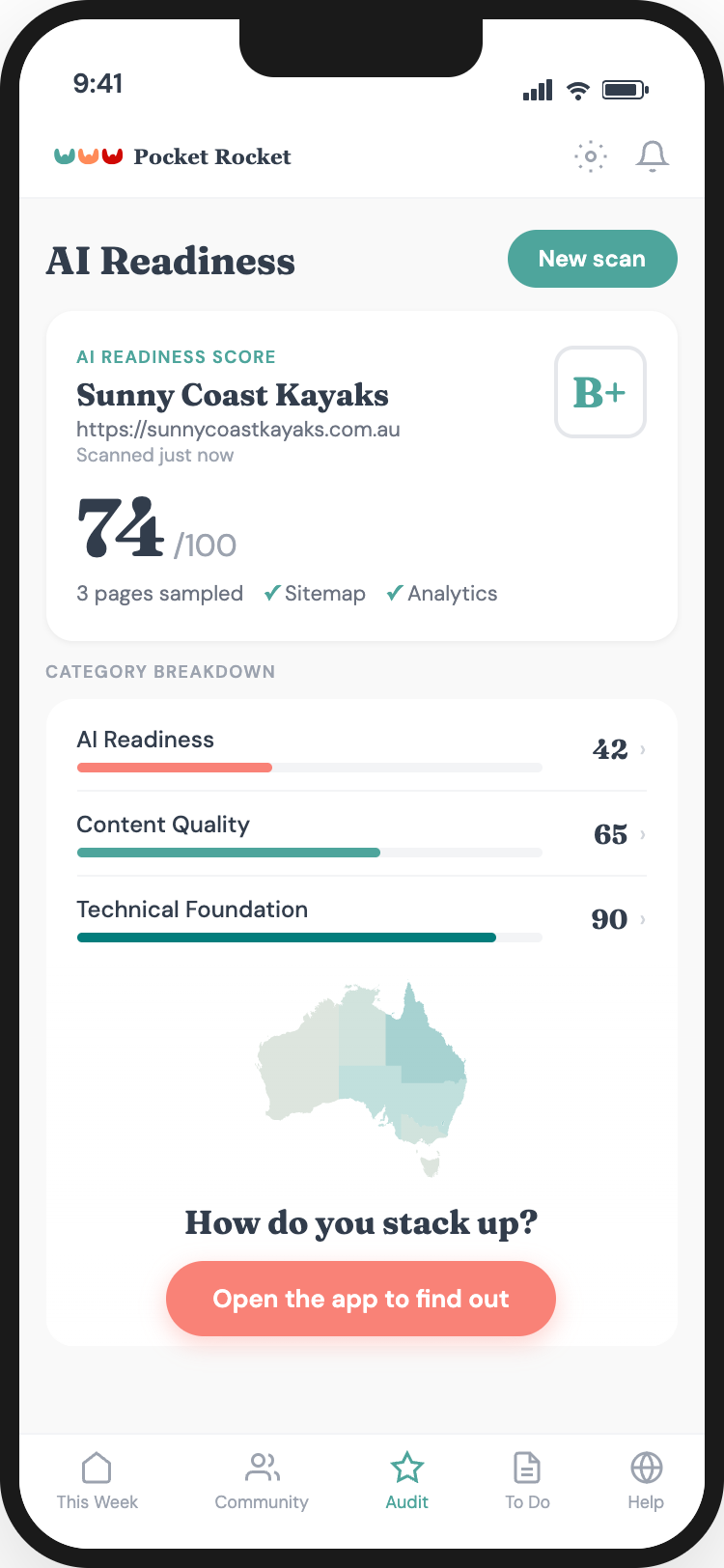
The playbook tells you what to do. Pocket Rocket shows you where you stand and tracks your progress. Free. No app store download. Add to your home screen at my.tourismtribe.com.
Free website audit
A-F grade across 8 AI visibility categories. One scan per week.
AI Readiness Index
See how your score compares to operators across Australia by state and industry.
AEO score
How your site performs for AI search. The metric Google Analytics does not show you.
Daily tips + challenges
Q2 tips focused on hyper-local marketing and tracking which markets are still moving.
Review Milker
AI-drafted review responses. Save 2-4 hours per week.
Direct coaching access
Connect with the Tourism Tribe team from inside the app.
FAQ
Common questions about AI and your business
What is answer engine optimisation (AEO) and why does it matter for my tourism business?
AEO is the practice of structuring your website content so it can be read, cited, and surfaced by AI tools like ChatGPT, Gemini, and Google AI Overviews. When a traveller asks an AI “what are the best things to do near your town”, AEO is what determines whether your business appears in the answer. Traditional SEO optimises for Google’s blue links. AEO optimises for the AI response that now appears above those links.
How is AI search different from Google search?
Google search returns a list of links. AI search returns a direct answer, drawn from multiple sources, synthesised into a response. The user often never visits a website. They get their answer and move on. This is why 63% of destinations saw year-on-year traffic declines in 2025. The journey happens inside the AI tool, not on your site.
Do I need a new website to be AI-ready?
No. Most AI visibility improvements are made through content and structure changes on your existing site. Adding a well-written FAQ page with schema markup, updating your Google Business Profile, and ensuring your key information is in plain text (not buried in images or PDFs) can move your score significantly without rebuilding anything.
Read more: Writing FAQs That AI Search Engines Actually Cite
What is a Google Business Profile and does it help with AI visibility?
Yes. A complete, accurate Google Business Profile is one of the highest-impact changes you can make for free. AI tools use this data when answering location-based queries. Make sure your hours, description, photos, and categories are current.
What is schema markup and do I need to know how to code?
Schema markup is a type of structured data you add to your website that tells search engines and AI tools exactly what your content is about. You do not need to code it yourself. SEO plugins like Rank Math or Yoast SEO can generate it for you automatically.
Read more: Schema Markup for Tourism: What Google Knows About Your Business
What is Pocket Rocket and what does it cost?
Pocket Rocket is a free progressive web app from Tourism Tribe. It gives you a weekly AI readiness audit of your website (A-F grade across 8 categories), three priority actions, an AEO score, daily tips, and access to Review Milker and Marketing Mate tools. No app store download needed. Add it to your home screen at my.tourismtribe.com. Free to use.
What does “AI agent” mean and do I need one?
An AI agent is an AI system that takes actions on your behalf. Not just answering questions, but doing tasks: booking confirmations, data entry, follow-up emails. Most tourism businesses are not ready for agents yet. They need documented processes first. But understanding what agents are helps you plan where you are heading.
What is the difference between ChatGPT, Claude, and Gemini?
All three are large language model AI tools. ChatGPT (OpenAI) is the most widely used. Claude (Anthropic) is known for longer, more nuanced responses and is strong for document analysis. Gemini (Google) integrates with Google Workspace and has strong image editing capabilities. For most tourism businesses, starting with ChatGPT and experimenting from there is the right approach. For destination marketing teams, we have published a detailed guide on AI search and destination discovery for DMOs.
Will AI write content that sounds like me?
Only if you tell it how you sound. Without a persona, a tone guide, and examples of your existing content, AI produces generic output. With that context (especially using Custom GPTs or Gemini Gems) the output gets close enough to edit quickly. The more context you provide, the better the result.
Where do I start if I have no AI experience?
Start with Pocket Rocket at my.tourismtribe.com. Scan your website and get your AI readiness score. The three priority actions it gives you are personalised to your business. They tell you exactly what to do first. Then come back to this playbook for the context behind those actions.
The Bottom Line
The bottom line
Tourism Operators
If you are currently spending three or more hours a week on content creation and still feeling behind, AI content tools will return that time to you within the first month. If your website is invisible to ChatGPT and Gemini, you are already losing bookings you do not know you are losing. An AI readiness audit and a structured FAQ page are the two highest-value changes most operators can make right now for under two hours of work.
Travel Sector
The efficiency gains are real and compounding. Operators who automated enquiry drafting in 2025 are now using that time on higher-value sales conversations. The businesses that have not adopted dynamic pricing are competing on a flat rate against operators who adjust in real time. The gap between early adopters and laggards in this sector is widening every quarter.
Regional Councils
A region where 70% of operators are invisible to AI search is a region with a visible, measurable problem at your next budget review. Commissioning operator audits and funding one structured training program this financial year gives you evidence of outcomes and a member base that is genuinely better prepared. The councils who invested early in digital capability programs saw operator retention and visitation data move. The same dynamic applies to AI readiness.
DMOs / STOs
Your members’ AI visibility is your destination’s AI visibility. When travellers ask ChatGPT “what are the best things to do in [your region]” and your operators do not appear in the answer, that is a measurable problem with a measurable fix. The DMOs who have run baseline audits across their member base, funded practical training, and deployed visitor chatbots are reporting outcomes they can take to boards and funding bodies. The ones who are still watching from the sidelines are falling behind regions that are not.
Ready?
AI is not coming. It is here.
The question is whether your organisation is using it, or being left behind by the ones that are.
No app store. No download. Add Pocket Rocket to your home screen at my.tourismtribe.com.